
ART | Painting the Threshold: How Women Artists Saw the Arrival of Autumn
Before autumn became an aesthetic, women painters were already studying its most fleeting transformation: the moment when summer light remains, the fields turn gold, and the landscape begins quietly preparing for another season.
Autumn rarely arrives all at once. September is more subtle than that. The trees have not necessarily surrendered their leaves, nor has the landscape become the fiery spectacle we now associate with the season. Instead, something happens to the light. Greens become duller. Fields dry into ochre and gold. Shadows lengthen. The same landscape that appeared almost endless in July suddenly seems aware of time. For painters working outdoors in the nineteenth and early twentieth centuries, these changes were not merely seasonal decoration. They were problems of color, atmosphere, light and perception. And for women artists, landscape could offer something else: access to a world beyond the portrait, drawing room and domestic interior to which women were so often culturally associated.
Women were never absent from landscape painting, but art history has frequently made them appear that way. They worked within restrictions that shaped their training, mobility and access to professional networks. Yet women traveled, studied abroad, painted outdoors, exhibited internationally and developed serious bodies of landscape work. Looking at autumn through their paintings gives us something more interesting than a collection of pretty seasonal scenes. It allows us to watch women claiming the right to observe the world.
Lilla Cabot Perry and the Color of Giverny
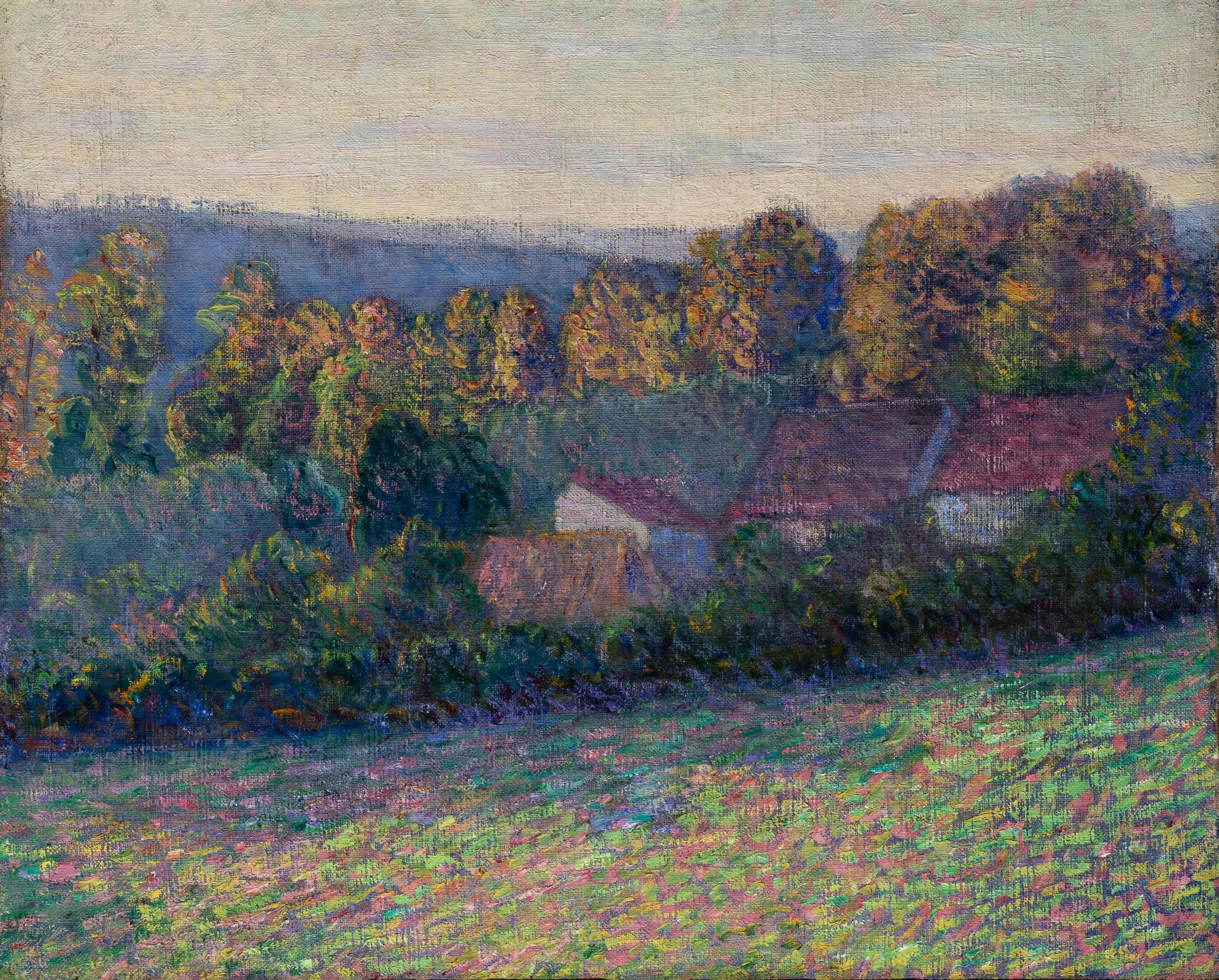
Few paintings fit September quite as beautifully as Lilla Cabot Perry's Autumn Afternoon, Giverny, painted around 1905–1909. The landscape is not yet the blazing red-orange autumn of postcards. Instead, Perry gives us a field shifting toward gold, farm buildings gathered beneath trees and darker foliage beginning to overtake the saturated greens of summer. The Terra Foundation for American Art describes the work as an intensely colored view of farm buildings nestled among trees beyond a field. (Terra American Art Collection)
It is precisely the kind of autumn that is easy to overlook.
Perry understood the Impressionist fascination with transient light intimately. She encountered French Impressionism relatively late in her artistic development, became friends with Claude Monet and spent nine extended summers with her family at Giverny. She eventually became an important advocate for Impressionism in the United States, helping introduce American audiences and collectors to a movement still regarded as radical by many viewers. She also spent several years in Japan, where exposure to Japanese prints influenced her approach to composition. (National Museum of Women in the Arts)
But Autumn Afternoon, Giverny is particularly compelling because Perry does not make autumn theatrical. The season is emerging through color. Summer has not vanished; autumn has begun occupying it.
That is September.
Artwork:Autumn Afternoon, Giverny, c. 1905–1909
Artist: Lilla Cabot Perry
Medium: Oil on canvas
Collection: Terra Foundation for American Art, Daniel J. Terra Collection (Terra American Art Collection)
Fanny Churberg: Autumn Without Politeness
If Perry's landscapes allow autumn to arrive through atmosphere, Fanny Churberg offers something rougher.
Churberg's landscapes resist the idea that nature exists simply to be pleasant. Her forests, skies and terrain can feel restless, forceful and emotionally charged. A 2024 exhibition pairing Churberg with Swedish painter Carl Fredrik Hill described her landscapes as dramatically rendered and expressive, characterized by strong color. (Sven-Harrys Konstmuseum)
That distinction matters because autumn itself has been domesticated in contemporary culture. We have made it cozy. Pumpkins, candles, blankets, cinnamon and carefully arranged leaves have transformed seasonal decay into an extraordinarily successful visual brand.
Churberg's landscapes remind us that nature is under no obligation to be cozy.
Autumn is beautiful precisely because something is happening to the landscape. Growth is slowing. Leaves are losing chlorophyll. Weather is becoming unstable. Plants are preparing for dormancy. Light is disappearing earlier each evening. Churberg's darker and more expressive landscapes allow nature to retain some of that wildness.
For a woman painting in the nineteenth century, there is also something significant about the scale of that attention. Nature is not background scenery behind a female subject. Nature is the subject.
Helen McNicoll and the Freedom of the Open Field
For Canadian Impressionist Helen McNicoll, the outdoor landscape became intertwined with movement and independence.
McNicoll traveled extensively at a time when women of her social class were still expected to inhabit comparatively restricted domestic worlds. The Musée national des beaux-arts du Québec describes her as an independent traveler whose work was distinguished by her command of light and atmospheric effects. The museum also notes something particularly important about her interpretation of Impressionism: she paid greater attention to women's labor than many of her contemporaries. (MNBAQ)
This makes her fields more than fields.
The rural landscape in nineteenth- and early-twentieth-century painting is often presented to modern viewers as an escape from industrial life, a beautiful world of grass, flowers and sunlight. Yet fields are also workplaces. Crops require planting and harvesting. Laundry must be washed. Children are cared for. Food is prepared. Animals are tended. The pastoral landscape contains labor even when the painter chooses not to show it.
McNicoll frequently did.
And perhaps that is where the female gaze upon landscape becomes particularly interesting. These women were not simply painting what nature looked like. They were painting environments women inhabited, traveled through and worked within.
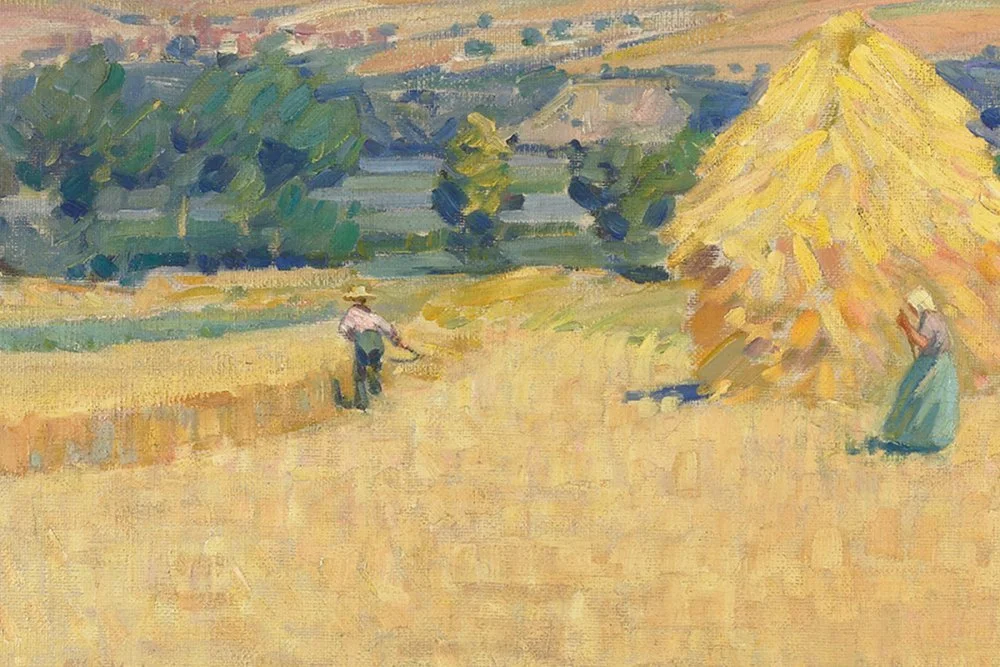
Helen McNicoll, Stubble Fields, c. 1912. Oil on canvas. National Gallery of Canada, Ottawa. McNicoll’s luminous treatment of the harvested field transforms agricultural labor and the fading warmth of the season into a study of light, color, and atmosphere.
Image/Collection Source: National Gallery of Canada, “Helen McNicoll: In Search of Light”
Who Was Allowed to Look?
The history of landscape painting is also a history of mobility. To paint the world, an artist has to be permitted to enter it.
That sounds obvious until we consider how profoundly gender influenced movement. Artistic training historically gave male artists forms of access women did not always receive equally. Travel could require money, permission, companionship and social freedom. Even the seemingly simple act of working outdoors could be complicated by expectations surrounding respectable female behavior.
Yet women went outside anyway.
Perry traveled through Europe and lived in Japan. McNicoll traveled extensively and built an artistic career around movement and observation. Churberg pursued landscape with an intensity that refused to make nature decorative. Their careers differed enormously, but collectively they challenge an old assumption that women artists naturally belonged indoors.
The landscape gave them scale.
A portrait may ask us to look at a person. A landscape asks us to consider where that person exists in relation to everything else.
The September Landscape
There is another reason these paintings belong in September rather than October. October announces itself. September requires attention.
It is the month of almost.
Almost autumn. Almost harvest. Almost bare branches. Almost cold.
The artistic challenge is therefore not simply to paint orange leaves. It is to recognize transition before transition becomes obvious.
Perry's Giverny landscape captures this beautifully. The field has changed before the entire world around it has. Churberg's landscapes remind us that seasonal change can be turbulent rather than decorative. McNicoll's sunlit fields ask us to consider the human beings who occupy the landscape rather than viewing nature as an empty stage.
Together, these women offer another way of seeing autumn.
Not as a collection of symbols.
Not as an aesthetic assembled from pumpkins and dried leaves.
But as observation.
The ability to stand before a landscape long enough to notice that yesterday's green has become today's gold.
Perhaps that is what painting has always done particularly well. A photograph can capture a fraction of a second, but a painting contains accumulated looking. The artist remains with the landscape, deciding which shadow matters, which color changed and where the eye should rest.
Women painters were doing that work even when the institutions writing art history did not always look back at them with equal attention.
September gives us an opportunity to look again.
The season is changing.
The women who painted it were paying attention.
Sources & Further Reading
Terra Foundation for American Art. “Autumn Afternoon, Giverny.” Collection record for Lilla Cabot Perry's c. 1905–1909 painting, including its medium, provenance, exhibition history and interpretation. (Terra American Art Collection)
National Museum of Women in the Arts. “Lilla Cabot Perry.” Biography detailing Perry's artistic development, relationship with Impressionism, years at Giverny and work in Japan. (National Museum of Women in the Arts)
Terra Foundation for American Art. “Lilla Cabot Perry.” Extended biography examining Perry's role in introducing Impressionism to American audiences and her development as a landscape and portrait painter. (Terra American Art Collection)
Musée national des beaux-arts du Québec. “Helen McNicoll: An Impressionist Journey.” Exhibition research examining McNicoll's travels, mastery of atmospheric light and particular attention to women's labor. (MNBAQ)
Sven-Harrys Konstmuseum. “Carl Fredrik Hill & Fanny Churberg: Towards a New Landscape.” Exhibition material examining Churberg's role in nineteenth-century Nordic landscape painting and her dramatic, expressive treatment of nature. (Sven-Harrys Konstmuseum)