

Daughters of the Unwritten by Giulia Costantini
Editor’s Note: The original title of this piece misspelled Giulia Costantini’s last name. This has been corrected.
I never called a woman “a witch.” The word felt unpleasant, unclear, ambiguous. I carried that discomfort even as a child, when my grandmother, with only a few gestures, made me understand that there was something else, a kind of knowing that was neither visible nor tangible to those who would never be able to perceive it.
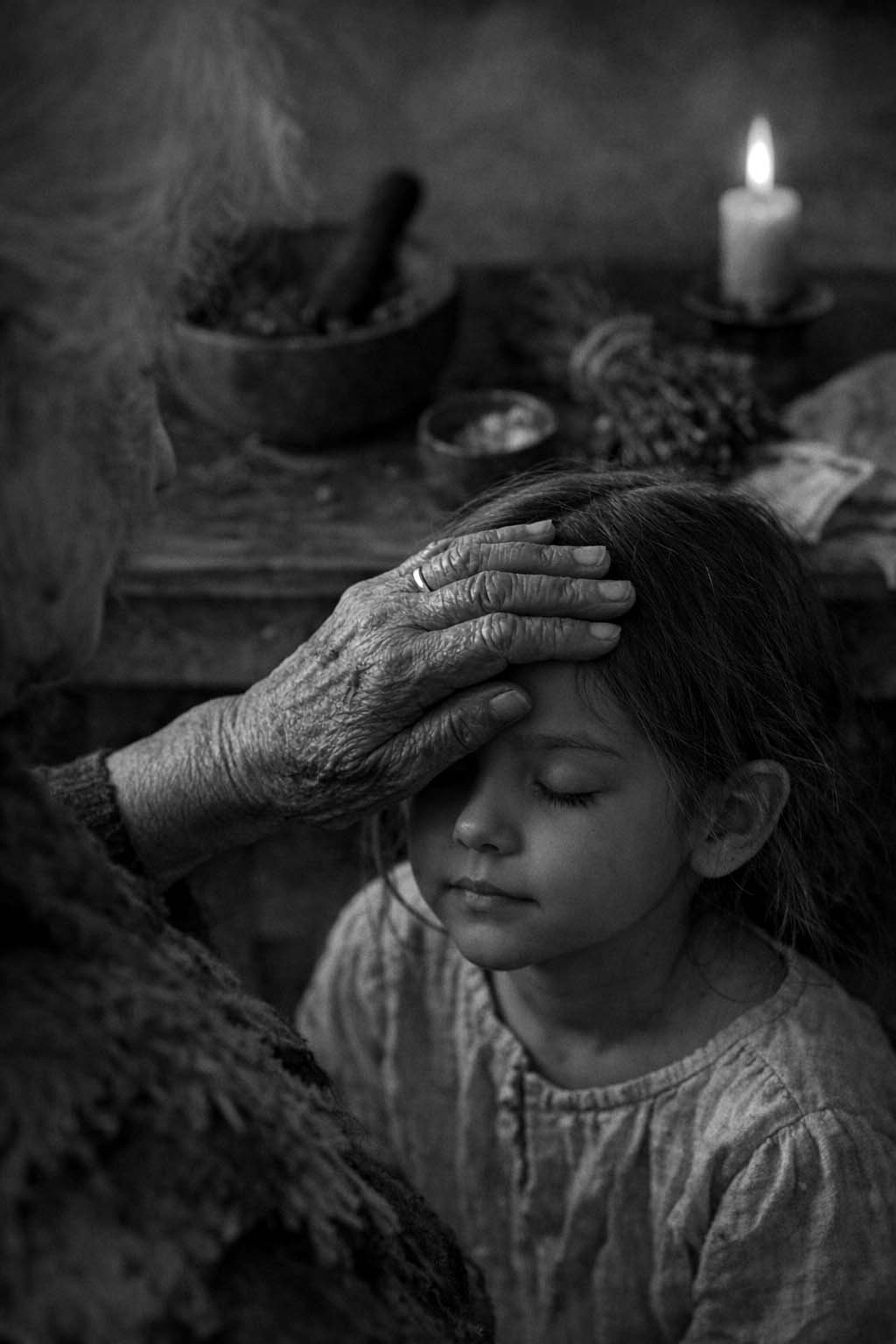
She did not explain it. She did not name it. She did not teach it the way things are taught in school. She let it happen. It was in the way she placed her hand on my forehead to measure a fever, in the silence that preceded the answer, in prayers whispered in tones that never fully resembled prayer.
I did not know that it was knowledge. I only knew that it worked. Only later did I begin to understand that what is not written is not therefore nonexistent. That there are forms of knowledge which do not ask for authorization, which do not pass through archives or institutions, and which for that very reason are perceived as dangerous.
What has been called “witchcraft” may have been, more simply, unwritten knowledge. A knowledge that lived in the body, in the repetition of gestures, in the silent transmission between women. It did not need to become doctrine, nor to be fixed in a text. It existed in daily practice, in care, in attention to imperceptible signs. It was a knowledge that did not declare itself as such. It did not present itself as authority. It did not seek legitimacy. For that reason, it was misunderstood, reduced to superstition, or transformed into threat.
What cannot be regulated becomes suspect. What cannot be archived becomes invisible. And yet invisible does not mean absent. It means kept elsewhere.
I grew up in a territory that rarely appears in books except as margin. Ciociaria is not a center. It never has been. It is a land of limestone hills and unfinished roads. Of voices that travel faster than paper, of economies built on endurance rather than recognition. Stories here circulate through kitchens and courtyards before they ever reach a page.
This is where I choose to begin. From the line that descends from Ciociaria into Southern Italy, across landscapes marked by distance from institutional power, yet dense with forms of intelligence that were never meant for lecture halls. Knowledge here moved through proximity: from mother to daughter, from neighbour to neighbour, across thresholds, through gestures repeated until they become memory.
In these territories, survival required attention. Attention to weather, to illness, to silence. Attention became literacy. Literacy of the body, of the land, of what trembles before it breaks.
In these peripheral geographies, the figure of the “witch” was never a fairy tale invention. She was a woman whose presence carried a special sort of weight. A woman who could read the body before diagnosis, the seasons before calendar, pain before it found language. She moved between thresholds, between birth and death, blessing and warning, remedy and risk. Sometimes she was called for in the dark. Sometimes she was spoken about in lowered voices. She occupied that fragile space between reverence and suspicion. The community depended on her and feared her in equal measure.
Her knowledge did not announce itself; it accumulated. In hands that remembered. In eyes trained to notice what others dismissed. In rituals so ordinary they escaped definition.
What could not be easily categorized was named excessive. What exceeded permission was called dangerous. And yet she persisted, not as a myth, but as continuity.
What remained unwritten was not empty. It was embodied, relational. It moved through touch, through repetition, through reception.
But what, precisely, remained unwritten about these women and what was called their magic?
Unwritten were the gestures that never entered magical record. Unwritten were the negotiations between fear and trust. Unwritten were the small calibrations of attention, the rituals that did not call themselves rituals, the whispered blessings, the repetitions, the precise timing of touch.
What remained unwritten was the structure of this knowledge: its logic, its pattern recognition, its disciplined observation of land, body, and season. It was not chaos. It was not superstition. It was an epistemology carried in flesh.
Their magic was never only incarnation. It was attunement. It was the capacity to remain in proximity to what others preferred to abstract, pain, birth, decay, desire, vulnerability.
What endured outside the page was not illusion, but practice. Not myth, but method.
This work begins there, in the texture of what was never archived, in the intelligence that survived without inscription, and in the forms of knowing that persisted beneath the official record of the South.