

An exploration of mortality, artistic expression, and humanity's enduring desire to preserve what time takes away.
Art has always served a purpose beyond decoration. Long before photographs could preserve a face or technology could capture a voice, human beings turned to images, objects, and monuments to remember what they feared losing.
We paint portraits of people who have passed. We preserve flowers from funerals, save letters written in familiar handwriting, and display objects that would otherwise hold little material value. These things become precious because of the memories attached to them.
But why do we turn loss into something beautiful?
Perhaps because art allows us to give physical form to something that no longer exists in the way we once knew it.
Memento Mori: The Beauty of Impermanence
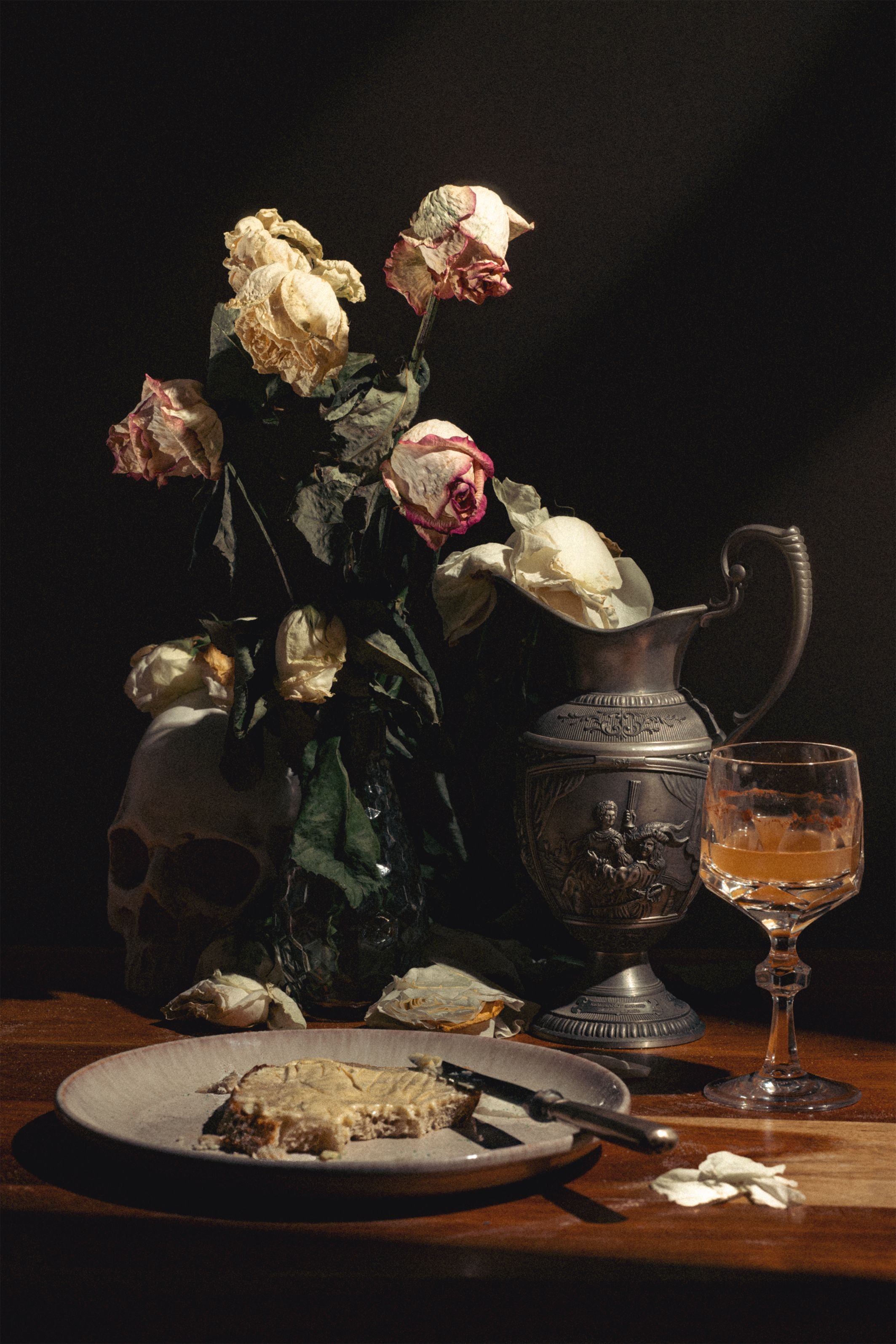
The Latin phrase memento mori, meaning "remember that you must die," has appeared throughout centuries of European art. Although its imagery can appear unsettling to modern audiences, the tradition was not simply an exercise in morbidity. It was an invitation to contemplate the brevity of human life.
During the seventeenth century, European artists, particularly in the Netherlands, developed an elaborate visual language around mortality. Paintings known as vanitas still lifes incorporated objects such as skulls, extinguished candles, hourglasses, wilting flowers, and musical instruments. Each object carried symbolic significance. A flower represented beauty vulnerable to decay. A candle suggested the temporary nature of existence. A skull made the ultimate conclusion unavoidable.
These compositions were often extraordinarily beautiful, filled with luminous colors, delicate textures, and remarkable technical precision. The contradiction was deliberate. In admiring the beauty of the painting, viewers were also invited to recognize its transience. Artists understood something we continue to confront today: beauty and impermanence are not opposites. Often, they are inseparable.
When Memory Becomes an Object
The desire to preserve remembrance through objects extends far beyond European painting.
Across different cultures and historical periods, people have created material expressions of relationships with those who have died. Portraits, funerary sculpture, textiles, decorated graves, and personal keepsakes serve different ceremonial and social purposes, yet they share an important quality.
They give memory somewhere to reside.
An object can become a connection between the present and the past. A photograph might preserve an expression that descendants never witnessed. A piece of jewelry might carry the story of someone whose name is no longer spoken. A handmade object can survive its creator and introduce their work to people who will never meet them.
Such objects do not eliminate absence. Instead, they make continued remembrance possible. This is especially significant when we consider how art preserves lives that written history may overlook. The work of ordinary people, particularly women and marginalized communities, has frequently survived through textiles, domestic crafts, personal adornment, and other forms of creative labor historically dismissed as decorative rather than artistic.
The meaning of these objects often exceeds their original practical purpose.
The Artist as Witness
Grief is not always expressed through recognizable images of death. Sometimes it appears through abstraction, repetition, fragmented figures, or landscapes emptied of human presence. An artist might return to the same subject repeatedly, attempting to understand something that cannot be resolved through language. Another might construct an entirely imaginary world in which a lost relationship can be examined from a different perspective.
The resulting work may not communicate a single, universal interpretation of grief. And perhaps that is precisely its value. Art permits ambiguity. It does not require the artist to arrive at acceptance, offer an explanation, or demonstrate emotional resolution. A painting can hold anger and affection simultaneously. A sculpture can embody both permanence and fragility. A photograph can document a moment while reminding us that the moment has already passed.
In this way, artistic expression becomes more than a record of experience. It creates a space in which difficult human emotions can exist without needing to be simplified.
Beyond Mourning
Although mortality has inspired countless works of art, the desire to remember is not limited to death. We create to preserve childhood, heritage, places, relationships, and versions of ourselves that no longer exist. Artists document disappearing landscapes and changing communities. Families preserve recipes and handmade objects. Photographers capture ordinary moments that may become extraordinary with the passage of time.
Memory is not static. It changes with those who carry it.
Art allows something from the past to enter a new conversation, sometimes long after its original meaning has changed. This does not make art an immortal record. Materials deteriorate. Interpretations shift. Even the most celebrated works can disappear.
Yet the act of creating remains a declaration that something was worth remembering.
What Remains
The history of art reveals a persistent human fascination with what survives us.
We know that flowers wilt, buildings crumble, memories fade, and even the most carefully preserved objects are vulnerable to time.
Still, we continue creating.
Perhaps the significance of art is not that it defeats impermanence, but that it acknowledges impermanence while refusing to treat human experience as meaningless.
A painting cannot restore the past. A photograph cannot reverse time. A sculpture cannot prevent loss.
But each can offer a place where remembrance continues.
And sometimes, that is what beauty is: not the absence of grief, but the evidence that something mattered enough to be remembered.
Research references
The historical discussion of memento mori and vanitas is supported by the Metropolitan Museum of Art, the National Gallery of Art, and the National Gallery, London
Photo credit: Christoph Georges