The Yellow Wallpaper and the Inner Room of the Mystic
Images courtesy “The Yellow Wallpaper” original printing
In 1892, Charlotte Perkins Gilman published the short story The Yellow Wallpaper, a haunting narrative that has long been interpreted as a critique of the medical treatment of women and the social confinement placed upon their lives. The story is written as a series of journal entries by a woman whose physician husband confines her to a room as part of the nineteenth century “rest cure,” forbidding her from writing, working, or engaging in intellectual activity.
At first glance, the story appears to document the psychological unraveling of a woman suffering from “nervous depression.” Isolated in a large summer house, she becomes increasingly fascinated by the disturbing yellow wallpaper in her room. With no other stimulation, she studies the strange patterns until she begins to see a figure trapped behind them.
But beneath the surface of psychological horror lies something deeper. The story can also be read as a symbolic exploration of consciousness, intuition, and the historical silencing of women’s inner experiences.
Mysticism often begins with withdrawal from the outer world. The mystic retreats into solitude and begins to observe the hidden patterns of reality. What appears ordinary at first begins to reveal deeper layers of meaning.
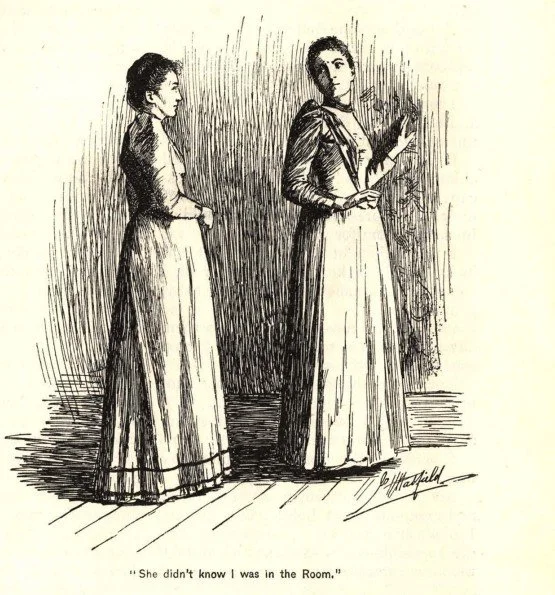
In The Yellow Wallpaper, the narrator’s isolation forces her into this same inward gaze. With nothing to occupy her mind except the strange designs on the wall, she begins to study them with almost meditative intensity. The chaotic pattern slowly transforms into something meaningful. She perceives a woman trapped within it, struggling to move beyond its bars.
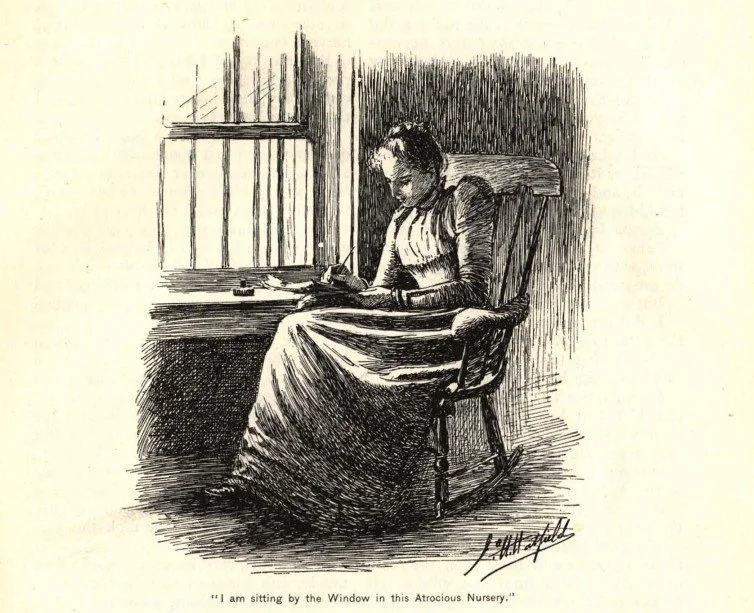
The wallpaper becomes a powerful metaphor for the structures that shape perception. Social rules, cultural expectations, and imposed identities can function like patterns that trap the self within them. The more closely the narrator observes the wallpaper, the more she begins to recognize the prison hidden within its design.
For many women throughout history, intuition and perception were dismissed as hysteria or instability. Experiences that might have been recognized as insight or spiritual awareness were instead pathologized. The narrator’s visions are treated in this way by her husband, who insists that nothing is wrong and forbids her from expressing her thoughts.
Yet the narrator persists in observing what others refuse to see.
Eventually she realizes that the figure trapped behind the wallpaper represents something deeper. The woman struggling behind the pattern is not only another presence. She is a reflection of the narrator herself, and perhaps of many women whose voices have been constrained by social expectation.
Her final act of tearing the wallpaper away becomes a symbolic moment of rebellion. She destroys the pattern that once defined her reality. Though this moment is often interpreted as madness, it can also be understood as an attempt to break free from the structures that confined her perception.
Through this lens, The Yellow Wallpaper becomes more than a psychological story. It becomes an exploration of the inner life and the struggle to reclaim one’s own vision of reality.
It is no accident that the narrator’s most powerful act is observation itself. She looks longer, deeper, and more carefully than anyone around her. In doing so, she uncovers the hidden architecture of the world she inhabits.
Mystics across cultures describe a similar process: the slow realization that the walls surrounding us are often constructed from patterns we have been taught not to question.
Within that realization lies the possibility of liberation.
Read the Full Story
You can read the complete public domain story here:
The Yellow Wallpaper by Charlotte Perkins Gilman
https://www.nlm.nih.gov/exhibition/theliteratureofprescription/exhibitionAssets/digitalDocs/The-Yellow-Wall-Paper.pdf