

Imbolc: The Ancient Festival of Returning Light
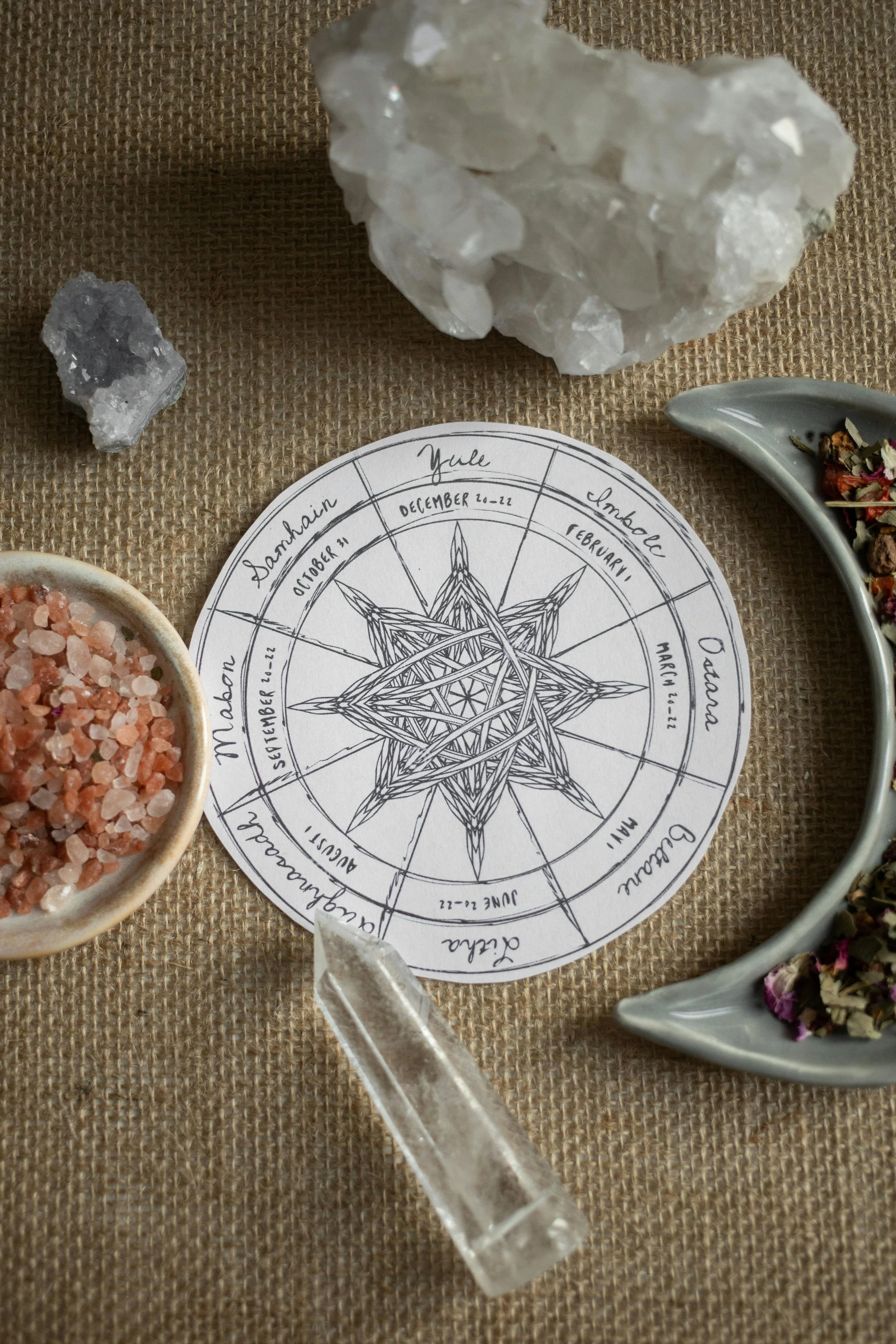
Image by Mosterra Studios
Imbolc is one of the oldest seasonal festivals in the European pagan calendar, marking the midpoint between the Winter Solstice and the Spring Equinox. Traditionally observed around February 1st or 2nd, Imbolc signals the quiet turning of the year from deep winter toward the first stirrings of spring. Although the land may still appear frozen and dormant, Imbolc has always been understood as a threshold. It is not the arrival of spring itself, but the moment when the light begins to return in noticeable measure. Days grow longer. The sun lingers slightly higher in the sky. Beneath the soil, seeds begin to awaken. For ancient agricultural societies, this subtle shift held profound importance.
Imbolc originates primarily from Celtic tradition and is closely associated with Ireland, Scotland, and parts of Britain. The word Imbolc is believed to derive from Old Irish, often translated as “in the belly,” referring to the pregnancy of ewes and the first signs of new life forming within animals. This period marked the beginning of lambing season, when sheep began producing milk again after the barrenness of winter. Milk became a powerful symbol of Imbolc, representing nourishment, fertility, and the quiet return of life. In pre-industrial cultures, survival depended on careful observation of seasonal cycles. People watched the behavior of animals, the condition of soil, and the quality of light to determine when the earth was shifting toward renewal. Imbolc was recognized not through abundance, but through potential. It honored what was beginning to move beneath the surface.
Central to Imbolc is the goddess Brigid, one of the most important deities in Celtic mythology. Brigid is a multifaceted goddess associated with poetry, healing, smithcraft, fertility, and sacred fire. She embodies both creativity and practical skill, spiritual inspiration and physical craftsmanship. Brigid is often understood as a bridge between worlds, governing thresholds and liminal spaces. Fire played a major role in her worship, not the roaring fire of summer, but the hearth fire. The steady flame that warms homes, cooks food, and sustains families through winter. At Imbolc, fires and candles were lit to honor Brigid and to welcome the strengthening sun.
This symbolism later blended into Christian tradition through Saint Brigid of Kildare, whose feast day also falls on February 1st. Many pre-Christian customs surrounding Brigid were absorbed into Christian practice, allowing older traditions to survive in adapted form. From an astronomical perspective, Imbolc is one of the four cross-quarter festivals, falling halfway between a solstice and an equinox. These midpoints were considered energetically potent because they marked transitions rather than extremes.
In astrology, Imbolc occurs during the season of Aquarius, a fixed air sign traditionally ruled by Saturn and in modern astrology by Uranus. Aquarius governs collective consciousness, future vision, innovation, reform, and intellectual awakening. This pairing is significant. While Imbolc is rooted in earth-based agricultural awareness, Aquarius carries the energetic quality of conceptual emergence. New ideas begin forming. New possibilities take shape. The future is not yet visible, but its blueprint starts to crystallize. Imbolc therefore represents a meeting point between earth and sky. On the land, seeds stir. In the psyche, intentions begin to clarify.
Historically, Imbolc was a festival of purification and preparation. Homes were cleaned. Hearths were tended. Tools were repaired. People took stock of remaining winter supplies and quietly prepared for planting season ahead. Rather than dramatic celebration, Imbolc was intimate and domestic, focused inward. Water also held symbolic importance during this time. Sacred wells dedicated to Brigid were visited for healing and blessing, as people believed the waters were especially potent at Imbolc, carrying restorative and purifying properties. Brigid herself is associated with both fire and water, reflecting the essence of Imbolc: fire as spark, water as womb. Together they express life beginning again.
Imbolc was never a festival of instant transformation. It did not promise sudden abundance or immediate warmth. Instead, it honored gradual change. Patience was embedded into the tradition. The ancestors understood that life unfolds in stages. Imbolc teaches that beginnings are often quiet. They do not always announce themselves. They appear as subtle shifts. A slightly longer day. A softening of the cold. A sense that something is turning.
Astrologically, this mirrors the early stages of any new cycle. Before planets form exact aspects, before eclipses reveal outcomes, there is a period of energetic gestation. Imbolc sits within this gestational phase of the year. It is a time when the future exists as possibility rather than form. The emphasis is not on harvest. It is not on manifestation. It is on tending the inner flame.
Across different regions, folk traditions developed around reading signs at Imbolc. Weather divination was common. Clear skies could indicate prolonged winter. Stormy conditions suggested that winter was expending its remaining energy and would soon release its grip. These customs reflect humanity’s long relationship with cyclical time. Rather than viewing time as linear and mechanical, ancient cultures experienced time as circular, alive, and responsive. Imbolc functioned as a reminder that life always moves, even when movement is not visible.
In modern spiritual culture, Imbolc is often framed as a time for intention setting. Historically, however, it was less about creating desires and more about readiness. Readiness of land. Readiness of home. Readiness of body. Readiness of spirit. The ancestors did not ask what they wanted from the year. They asked what needed tending so that life could continue. From an astrological lens, Aquarius season supports this orientation. Aquarius concerns itself with systems, structures, and long-term evolution. It asks not only what we desire, but what we are building.
Imbolc aligns with this question. What foundation is forming beneath your life. What quiet changes are underway. What inner fire still burns, even after winter.
Imbolc reminds us that hope does not always arrive as excitement. Sometimes hope arrives as endurance. Sometimes as a small candle in a dark room. Sometimes as the simple knowing that winter is not eternal. This festival has survived thousands of years because it speaks to a universal human experience: the experience of waiting, the experience of trusting cycles, the experience of carrying light through darkness.
Imbolc does not promise instant rebirth. It promises continuity. Life continues. The wheel keeps turning. The light returns. And it always has.
